
by: Deacon Adel Abrugena
My dear brothers and sisters, today’s readings speak about something that is simple to understand, but incredibly difficult to practice: forgiveness.
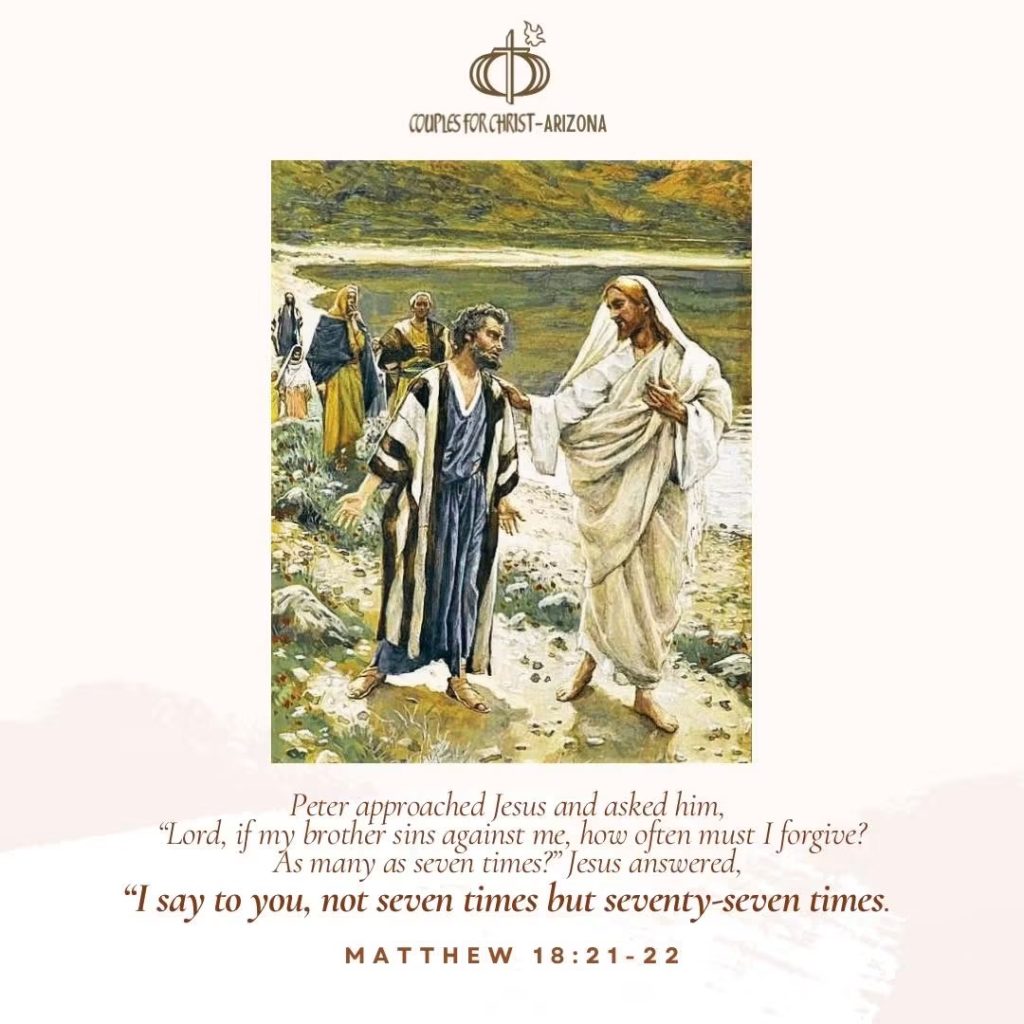
In the Gospel, Peter asks Jesus, “Lord, if my brother sins against me, how often must I forgive? As many as seven times?” Peter expected a pat on the back. In the ancient world, forgiving someone three times was considered holy. Seven times was going above and beyond. But Jesus completely shatters his expectations. He answers, “Not seven times, but seventy-seven times.” In other words, true Christian forgiveness has no limit.
Let’s be honest: this is a difficult Gospel. It is difficult because forgiveness always sounds much easier when we are talking about somebody else’s problems. It sounds beautiful in a book. But it becomes agonizingly hard when we are the ones who have been betrayed, lied to, forgotten, or broken.
To live out this Gospel, we have to understand what forgiveness actually is and what it is not.
Forgiveness does not mean pretending that nothing happened. It does not mean saying that what someone did was acceptable. It does not mean forgetting the pain or erasing your memory. And forgiveness certainly does not mean that you allow someone to continue abusing or hurting you. Sometimes, Christ calls us to set firm boundaries. Sometimes, we need to pursue justice.
But forgiveness does mean this: it means we refuse to allow another person’s wrongdoing to take permanent possession of our hearts. Forgiveness is when you can look at a wound and say, “What you did was wrong. It hurt me deeply. But I will not allow your sin to turn me into a bitter person.” That is the freedom Christ offers us.
This call to refuse bitterness is urgent for every single one of us, but it is especially vital in our closest relationships within our homes, our families, and our marriages.
For those here who are married, you know that the person you love the most is often the person with the greatest power to hurt you. Think about how it happens in day-to-day life. A husband says something reckless in a moment of exhaustion. A wife responds in flash-fire anger. Someone forgets a promise. Someone makes a costly mistake with money.
And what do we do? Sometimes, we carry these little hurts. One becomes two. Two becomes ten. Ten becomes a mountain. And eventually, you aren’t even arguing about what happened today anymore. You are arguing about everything that happened five years ago. We start keeping score.
Brothers and sisters, when we begin keeping score, love becomes a courtroom. And our homes were never meant to be courtrooms. There are no prosecutors or judges at the altar. Relationships are meant to be a sanctuary, a place where imperfect people help each other get to heaven.
For the widows and widowers among us today, you know the profound truth of this reality. You understand how incredibly precious and short our time together truly is. Looking back on a lifetime shared, the petty arguments of twenty years ago fade into absolute insignificance. What remains is the love, the grace, and the moments where mercy won. A successful relationship is simply two good forgivers who never gave up on each other.
Every single day, we make deposits into our relationships with our spouses, our children, our siblings, and our closest friends. A kind word is a deposit. Saying “thank you” is a deposit. Listening without interrupting, a warm hug, saying “I’m sorry” these are all deposits. But saying “I forgive you” is one of the greatest deposits you can ever make. Do not wait until resentment has accumulated for a decade. Don’t keep a ledger of mistakes. Don’t let pride rob you of the three sentences that can save a relationship: “I’m sorry.” “I forgive you.” “Let’s begin again.”
As a parish family, we have a beautiful guide in this spiritual work. Our patron saint, Saint Odilia, is the patroness of good eyesight. Tradition tells us she was born physically blind, but when she was baptized, her eyes were opened to the light.
There is a powerful spiritual lesson there for us today. Resentment, anger, and holding onto grudges is a form of spiritual blindness. When we hug our anger tight, we become blind to the goodness in others. We become blind to the blessings around us, and we become blind to the massive debt of sin that God has already forgiven in our own lives. But when we choose to forgive from the heart, a miracle happens. Just like Saint Odilia, our eyes are opened. The darkness of bitterness leaves us, and we can finally see our loved ones through the eyes of Christ with mercy, compassion, and truth.
Now, perhaps someone sitting in the pews today is thinking, “Deacon, that sounds nice. But what if the person isn’t sorry? What if they never apologize?”
Our forgiveness cannot be dependent upon another person’s apology. We can forgive while still maintaining healthy boundaries. And we must recognize that forgiveness is often a slow process, not a one-time event. For those who have been deeply wounded, Christian forgiveness takes time. There is a massive difference between the legitimate anger of a wounded soul and a nourished anger that transforms into hatred.
If you are struggling today, let forgiveness begin with a simple prayer: “Lord, I cannot change this person. I cannot force them to see the truth. But I refuse to carry this poison anymore. I place them, and this wound, into Your hands through the intercession of Saint Odilia.” And then, you do it again tomorrow. Because the memory will come back. The pain will flare up. And in that moment, you make the decision again: “Jesus, I give this to You.”
We have the power to do this because we have been radically forgiven. Before we start counting what others owe us, we have to look at the massive debt God has wiped clean for us. Think about how patient God has been with you. Think about how many times you have fallen, how many times you have promised, “Lord, I will never do it again,” and then failed the exact same way the next day. And yet, what does God do? He welcomes us back with total love.
We do not forgive because the other person deserves it. We forgive because we have received a mercy we could never deserve.
So, what is our practical challenge for this week?
Before you go to sleep tonight, look into your heart and ask yourself: “Is there someone I am still carrying? Is there resentment I am hugging tight?” Maybe it’s your spouse. Maybe it’s an estranged child or parent, a brother, a sister, a friend. . Ask yourself: “Am I willing to place them in God’s hands tonight?”
Tomorrow is never guaranteed. Our time on this earth is far too short, and the people God has placed in our lives are far too precious, to waste even one more day carrying yesterday’s anger.
Through the prayers of Saint Odilia, may our spiritual blindness be healed. Receive God’s mercy. Offer that mercy to others. And perhaps the road to heaven begins tonight with just three simple words: “I’m sorry.” “I forgive you.” “Let’s begin again.”
Let us invest in our love stories. Amen.